Running paid search campaigns often seems straightforward: select targeted search terms, set a daily budget, and wait for inbound leads. However, without precise campaign architecture, ad spend quickly evaporates on irrelevant clicks and low-intent traffic.
Managing performance campaigns across competitive markets like Dubai as well as rapidly expanding regional business hubs like Calicut and Thamarassery has shown me that sustainable ad profitability comes down to negative keyword hygiene, conversion tracking integrity, and landing page alignment. Working alongside a dedicated Google Ads expert in Calicut can streamline this entire optimization process, ensuring campaigns target real commercial intent rather than wasted clicks.
This guide outlines actionable methods to scale your Google Ads campaigns, cut wasted ad spend, and maximize your return on ad spend (ROAS).
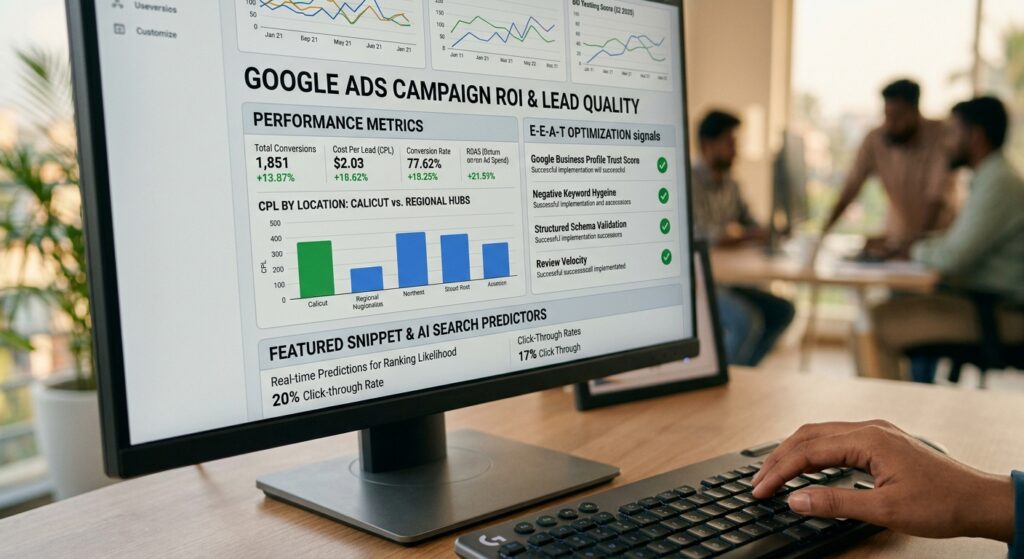
Why Google Ads Budgets Drain Without Conversions
Google Search Ads capture immediate user intent—people actively searching for solutions. Yet, budget inefficiency remains a major challenge for service businesses.
| Unfiltered Match Types | Tracking Gaps |
| Loose Geo targeting | Ads serving outside core service delivery radiuses |
| Tracking Gaps | Smart Bidding algorithms operating on incomplete conversion data |
4 Actionable Steps to Optimize Google Ads for High ROI
1. Build Multi-Tiered Negative Keyword Lists
The fastest way to lower acquisition costs is eliminating wasted impressions.
- Audit your Search Terms report weekly to identify non-converting query patterns (e.g., “free,” “jobs,” “course,” or “pdf”).
- According to campaign architecture documentation on Google Ads Help, applying account-level negative keyword lists prevents broad-match keywords from burning budget on irrelevant searches.
2. Restructure Campaigns around Single Intent Groups (STAGs)
Grouping dozens of unrelated keywords into one ad set dilutes your Quality Score, which directly increases your cost-per-click.
- Organize ad groups tightly around 3 to 5 closely related search terms.
- Write tailored responsive search ads (RSAs) for each group so that headlines match the user’s exact search query.
3. Deploy Localized Radius & Location Asset Targeting
Avoid using default location settings like “Presence or Interest.” Instead, set target parameters strictly to “Location: People in or regularly in your targeted locations.”
Consulting an experienced Google Ads expert in Calicut allows local service businesses to tailor bid adjustments precisely around high-value postcodes and regional competition levels.
For regional service providers, combining local extension assets with specific city targeting yields far higher local buyer intent.
4. Implement Enhanced Conversions & Server-Side Tracking
Relying solely on standard client-side conversion tags results in missing attribution data due to modern browser privacy restrictions. Setting up Google Enhanced Conversions passes hashed first-party data securely back to Google’s bidding engine, giving automated strategies (like Maximize Conversions or Target CPA) accurate data to target high-value buyers.
Frequently Asked Questions
Frequently Asked Questions
How long does it take to see positive ROI from Google Ads?
Initial campaign optimization takes 2 to 4 weeks while the bidding algorithm passes through its learning phase. Account profitability typically stabilizes within 60 to 90 days as negative keyword lists build out and conversion data accumulates.
Why should a business consult a Google Ads expert in Calicut instead of running automated smart campaigns?
Google’s automated Smart Campaigns are designed for ease of setup, not cost efficiency. A qualified Google Ads expert in Calicut actively manages negative keyword match types, optimizes landing page conversion rates, and sets up custom bid strategies that prevent automated algorithms from overspending on broad search queries.